

 Anabelle Mclean
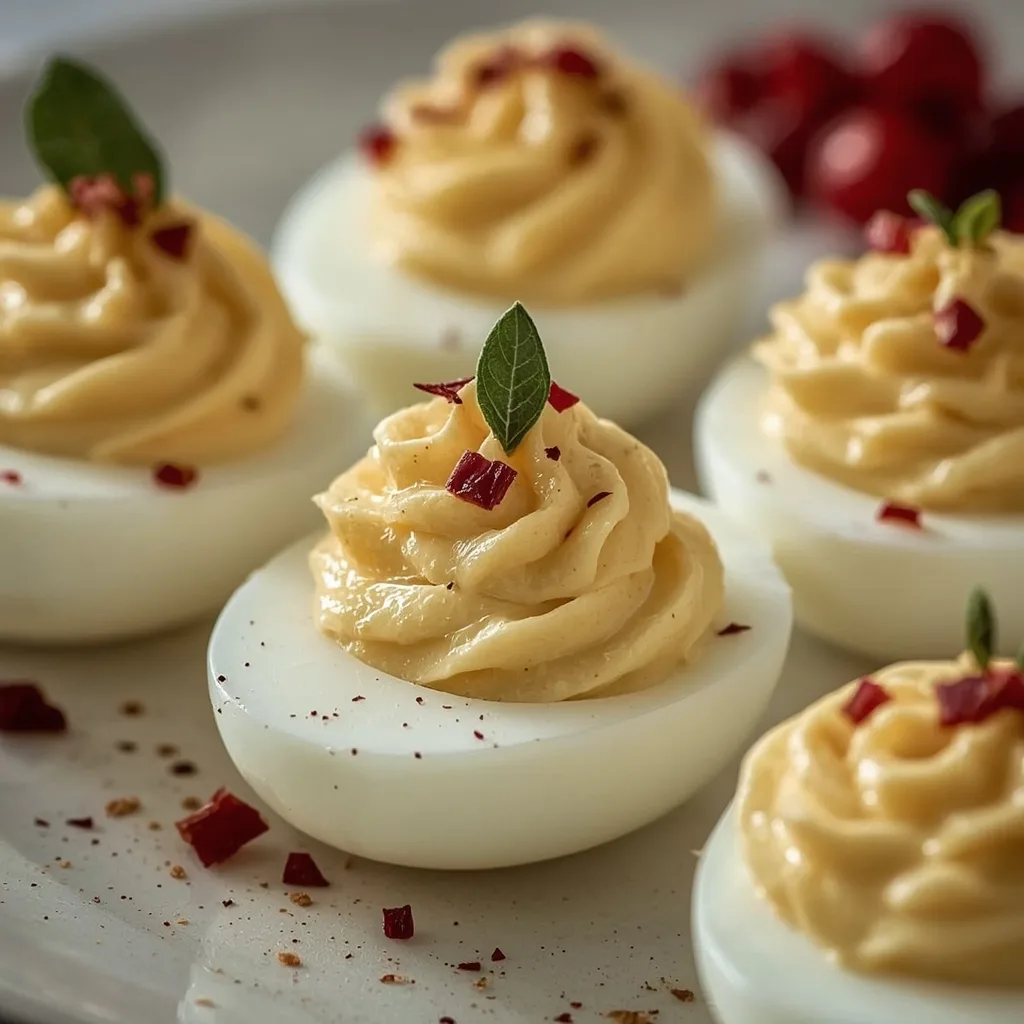
 Thanksgiving Deviled Eggs take the classic party appetizer and give it a seasonal twist with roasted turkey, fresh sage, and a bright cranberry topping. The filling is rich and silky, the fried sage adds a crispy, savory crunch, and the cranberry delivers a tart-sweet pop that balances every bite.
The whole recipe comes together in 40 minutes, making it an intermediate-level dish that is perfect for Thanksgiving appetizers, Friendsgiving spreads, or any holiday gathering. The trickiest part is frying the sage without letting it brown, but the visual cue is easy to spot once you know what to look for.
What Is Thanksgiving Deviled Eggs?
This dish is a holiday appetizer made from hard-boiled egg whites filled with a creamy yolk mixture that includes mayonnaise, Dijon mustard, minced roast turkey, and fresh sage. Each filled egg gets topped with cranberry relish and a crisp fried sage leaf. The texture is smooth and velvety from the whipped yolks, with savory roasted turkey flavor running through every bite. The cranberry adds a bright, tangy contrast that cuts through the richness, making it a standout on any holiday appetizer board.
Reasons to Try Thanksgiving Deviled Eggs
These are not your average picnic deviled eggs. The combination of turkey and cranberry turns a familiar snack into something festive and memorable.
- Festive presentation — the piped swirl, jewel-toned cranberry, and fried sage leaf make each egg look like a tiny holiday centerpiece.
- Balanced flavor profile — creamy, savory, smoky, and tart-sweet notes hit in every single bite.
- Uses up leftovers beautifully — if you have roasted turkey breast from the big meal, this is a smart way to repurpose it.
- Make-ahead friendly — components can be prepped a day in advance, so assembly is quick before guests arrive.
- Crowd-pleasing familiarity — everyone recognizes deviled eggs, but the seasonal add-ins make them feel new.
- No special equipment needed — a piping bag helps, but a zip-top bag with a snipped corner works just as well.
Ingredients Needed to Make Thanksgiving Deviled Eggs
You likely have most of these staples already. The turkey and cranberry do the heavy lifting here.
Base Ingredients
- 6 large cold eggs — cold eggs are easier to peel after the ice bath; look for eggs that are at least a few days old for the cleanest shell release.
- 1/4 cup full-fat mayonnaise — full-fat gives the creamiest texture; light mayo makes the filling looser and less stable for piping.
- 1 tablespoon Dijon mustard — adds sharpness and depth; whole-grain mustard works as a swap if you like more texture.
Seasonings
- 1/4 teaspoon fine sea salt — plus more for the cooking water, which helps shells separate cleanly if cracking happens.
- 1/8 teaspoon freshly ground black pepper — grind it fresh for a brighter, more aromatic kick.
- 1/4 teaspoon smoked paprika — brings a subtle smoky note that echoes the roasted turkey; extra is used for garnish.
Mix-Ins and Toppings
- 3 tablespoons cooked roast turkey breast, very finely minced — the finer the mince, the smoother the filling pipes; deli turkey works in a pinch but roast turkey has better flavor.
- 1 tablespoon fresh sage leaves, very finely minced — chopped sage infuses the filling with earthy, peppery warmth; dried sage is not a good substitute here.
- 12 small whole sage leaves — fried in butter for a crispy, savory garnish that looks as good as it tastes.
- 2 tablespoons unsalted butter — for frying the sage; unsalted gives you full control over saltiness.
- 3 tablespoons cranberry relish or whole-berry cranberry sauce, drained — the tart-sweet topping; drain excess liquid so it does not bleed into the filling.
- 1 tablespoon fresh chives, thinly sliced — a fresh, oniony finish scattered over the platter.
Instructions to Prepare Thanksgiving Deviled Eggs
Here is every step, in order, with the details that actually matter for getting it right the first time.
- Boil the eggs — place the 6 cold eggs in a single layer in a medium saucepan and cover them with cold water by 1 inch. Add 1 teaspoon of fine sea salt to the water to help the shells separate cleanly if cracking occurs.
- Rest off the heat — set the saucepan over medium-high heat and bring the water to a rolling boil. Remove the pan from the heat as soon as the water reaches a full, vigorous boil, cover tightly, and let the eggs sit undisturbed for exactly 12 minutes. Do not lift the lid during this time.
- Shock in an ice bath — while the eggs cook, fill a medium bowl halfway with ice cubes and cold water. Transfer the eggs to the ice bath immediately when the 12 minutes are up and let them chill for at least 5 minutes. This stops the cooking and prevents that gray-green ring around the yolks.
- Fry the sage garnish — melt the 2 tablespoons of unsalted butter in a small skillet over medium heat. When the butter foams and then the foaming subsides, add the 12 whole sage leaves in a single layer. Fry for 30 to 45 seconds per side, until darkened and crisp but not browned. Watch closely — they go from crisp to burnt fast.
- Peel the eggs — tap each cooled egg gently on the counter to crack the shell, then roll it between your palm and the counter to loosen the shell all over. Peel under a thin stream of cold running water to release stubborn fragments, then pat dry with paper towels.
- Halve and separate — slice each peeled egg in half lengthwise with a sharp chef’s knife. Pop the yolks into a medium mixing bowl, using a small spoon to coax out any that stick. Set the whites cut-side up on a serving platter.
- Build the yolk base — mash the yolks with a fork until they form a fine, even crumble with no large lumps. Add the 1/4 cup mayonnaise, 1 tablespoon Dijon mustard, 1/4 teaspoon fine sea salt, 1/8 teaspoon black pepper, and 1/4 teaspoon smoked paprika. Stir until completely smooth and creamy, scraping the sides of the bowl.
- Fold in the mix-ins — add the 3 tablespoons of minced roast turkey and 1 tablespoon of minced fresh sage. Fold gently with a rubber spatula until evenly distributed. The filling should be thick enough to hold its shape when piped but still silky.
- Pipe the filling — transfer the filling to a piping bag fitted with a large star tip, or use a zip-top bag with the corner snipped off. Pipe generously into each egg white half using a circular motion to create a swirled peak that rises about 1/2 inch above the white.
- Add the toppings — top each filled egg with about 1/2 teaspoon of the drained cranberry relish, nestling it gently into the piped swirl. Place one fried sage leaf on top of the cranberry on each egg.
- Finish and serve — sprinkle the eggs lightly with extra smoked paprika and scatter the 1 tablespoon of sliced fresh chives over the entire platter. Serve immediately for the best texture, or cover and refrigerate for up to 4 hours before serving.

What Goes Well With Thanksgiving Deviled Eggs
These savory bites fit right into a larger spread of holiday appetizers and party snacks. Here is what pairs best.
- Cheese board — sharp cheddar, aged gouda, and creamy brie echo the richness of the filling while offering contrasting textures.
- Roasted nuts — candied pecans or smoked almonds add crunch and a sweet-savory note that mirrors the cranberry topping.
- Crudité platter — crisp celery, radishes, and endive leaves give a fresh, clean counterpoint to the creamy eggs.
- Sparkling cider or a dry white wine — effervescence cuts through the richness and resets the palate between bites.
- Pumpkin or butternut squash soup shooters — warm, velvety soup in small cups makes a cozy pairing for a fall party menu.
- Mini turkey sliders — if you are serving a crowd, these eggs sit perfectly alongside small sandwiches for a fuller spread.
Key Tips for Making Thanksgiving Deviled Eggs
After testing this recipe multiple times, here is what actually makes the difference between good eggs and great ones.
- Timing the yolks right — 12 minutes off the heat produces fully set yolks with no gray ring. Even 60 seconds over changes the texture and color.
- Mincing the turkey ultra-fine — chunky turkey clogs the piping tip and breaks the swirl. Take the extra minute to get it nearly paste-like.
- Draining the cranberry thoroughly — excess liquid from the relish will bleed into the filling and make it weepy. Press it gently with paper towels if needed.
- Frying sage at the right temperature — the butter should stop foaming before the leaves go in. If it is still sizzling hard, the sage will brown instead of crisp.
- Piping with steady pressure — squeeze evenly and lift slowly at the end to create that clean, swirled peak. Practice on one egg first.
- Peeling under running water — cold water gets between the membrane and the white, making shell removal dramatically easier and neater.
- Assembling close to serving time — the filling stays silky and the sage stays crisp for about 4 hours. After that, texture starts to decline.
Creative Variations of Thanksgiving Deviled Eggs
Once you have the base method down, these twists let you adapt the recipe to different tastes and occasions.
- Maple-Bacon version — swap the turkey for finely crumbled crispy bacon and add 1/2 teaspoon of maple syrup to the yolk mixture for a sweet-smoky riff.
- Herb-Forward version — replace the minced sage with a mix of fresh thyme, rosemary, and chives for a brighter, more aromatic filling.
- Smoked Turkey version — use smoked turkey breast instead of roasted for a deeper, more pronounced savory flavor that stands up to the cranberry.
- Cranberry-Orange version — stir 1/2 teaspoon of orange zest into the cranberry relish and swap the sage garnish for a tiny strip of orange peel.
- Spicy version — add 1/4 teaspoon of cayenne or a few drops of hot sauce to the yolk mixture, and top with pickled jalapeño instead of cranberry.
- Bacon-Wrapped version — wrap each filled egg half with a thin strip of partially cooked bacon and bake at 375°F for 5 minutes before topping.
Storage Guidelines for Thanksgiving Deviled Eggs
These are best enjoyed fresh, but proper storage keeps them safe and reasonably good for a couple of days.
- Refrigerator storage — keep leftover eggs in an airtight container separated by layers of parchment paper for up to 2 days.
- Sage refresh method — the fried sage loses its crispness once refrigerated; re-crisp it in a 300°F (150°C) oven for 2 to 3 minutes.
- Filling-only storage — if you want to prep ahead, store the filling and egg white halves separately in airtight containers in the refrigerator for up to 1 day.
- Unassembled components — boiled and peeled eggs keep well for 1 day refrigerated; the cranberry relish and fried sage are best made fresh.
- Freezing — do not freeze this dish. Egg whites and the creamy filling both become watery and rubbery when thawed.
Reheating Tips for Thanksgiving Deviled Eggs
This dish is served cold or at room temperature, so reheating is rarely needed. If the fried sage needs a refresh, here is how to bring it back.
- Oven method — place the fried sage leaves on a parchment-lined baking sheet and heat at 300°F (150°C) for 2 to 3 minutes until crisp again. Watch them closely so they do not burn.
- Room temperature method — if the filling thickened too much after chilling, let it sit at room temperature for 10 minutes and stir before piping. No heat required.
- Do not microwave — microwaving the assembled eggs turns the whites tough and makes the filling separate. This dish is not meant for the microwave.
Nutrition Value (Per Serving)
Based on 1 serving = 3 egg halves out of 12 total (4 servings per recipe).
- Calories — 245
- Protein — 11g
- Fat — 20g
- Carbohydrates — 4g
- Fiber — 0g
- Sugar — 3g
- Sodium — 310mg
FAQs
How long do Thanksgiving Deviled Eggs last in the fridge?
They keep for up to 2 days when stored in an airtight container separated by layers of parchment paper. The texture of the filling stays decent, but the fried sage will soften.
Can I make Thanksgiving Deviled Eggs ahead of time?
Yes. Boil and peel the eggs up to 1 day in advance, keeping the whites and yolks separate in airtight containers in the refrigerator. Assemble the filling and pipe the eggs up to 4 hours before serving.
Can I freeze Thanksgiving Deviled Eggs?
No. Freezing causes the egg whites to become watery and rubbery, and the creamy filling separates upon thawing. This appetizer is best made and enjoyed fresh.
What can I use instead of turkey?
Deli roast turkey works if you mince it finely, but roasted turkey breast has better flavor and texture. For a vegetarian option, swap the turkey for finely chopped smoked almonds or crispy shallots.
Why did my fried sage turn brown instead of staying green?
The butter was likely too hot. Wait until the foaming subsides before adding the leaves, and fry them for only 30 to 45 seconds per side. They should darken slightly but stay green.
How do I keep the cranberry from sliding off the eggs?
Drain the cranberry relish thoroughly before spooning it on, and nestle it gently into the piped swirl. The swirl creates a small well that holds the topping in place.
Try These Popular Recipes
- Million Dollar Deviled Eggs
- The Best Deviled Eggs for Thanksgiving
- Pumpkin-Shaped Deviled Eggs
- Make-Ahead Thanksgiving Deviled Eggs
Wrapping Up
Thanksgiving Deviled Eggs bring together everything great about the holiday table in one tidy, two-bite package. The creamy turkey-sage filling, crisp fried sage leaf, and bright cranberry topping make them a memorable addition to any appetizer spread. Whether you are hosting a full Thanksgiving dinner or bringing a dish to a Friendsgiving potluck, this recipe delivers festive flavor with surprisingly little effort. Give it a try — it might just become your new holiday tradition.
PrintThanksgiving Deviled Eggs

These Thanksgiving deviled eggs transform the classic appetizer into a festive holiday bite, with a creamy filling that echoes roasted turkey, sage, and cranberry. The yolks are whipped with mayonnaise, Dijon mustard, and finely minced roasted turkey, then topped with a jewel-like cranberry relish and crispy fried sage. Each bite is silky, savory, and balanced by a bright pop of tart-sweet cranberry.
- Prep Time: 25
- Cook Time: 15
- Total Time: 40
- Yield: 4 1x
- Category: Snack
- Method: Stovetop
- Cuisine: American
Ingredients
- 6 large eggs, cold from the refrigerator
- 1/4 cup mayonnaise, full-fat
- 1 tablespoon Dijon mustard
- 1/4 teaspoon fine sea salt, plus more for the egg water
- 1/8 teaspoon freshly ground black pepper
- 1/4 teaspoon smoked paprika, plus extra for garnish
- 3 tablespoons cooked roast turkey breast, very finely minced
- 1 tablespoon fresh sage leaves, very finely minced, plus 12 small whole sage leaves for frying
- 2 tablespoons unsalted butter
- 3 tablespoons cranberry relish or whole-berry cranberry sauce, excess liquid drained
- 1 tablespoon fresh chives, thinly sliced, for garnish
Instructions
- Place the 6 cold eggs in a single layer in a medium saucepan and cover them with cold water by 1 inch. Add 1 teaspoon of fine sea salt to the water to help the shells separate cleanly if any cracking occurs during cooking.
- Set the saucepan over medium-high heat and bring the water to a rolling boil. As soon as the water reaches a full, vigorous boil, remove the pan from the heat, cover it with a tight-fitting lid, and let the eggs sit undisturbed in the hot water for exactly 12 minutes.
- While the eggs cook, prepare an ice bath by filling a medium bowl halfway with ice cubes and cold water. When the 12 minutes are up, use a slotted spoon to transfer the eggs immediately to the ice bath and let them chill for at least 5 minutes to stop the cooking and prevent a gray-green ring around the yolks.
- Meanwhile, fry the sage garnish: melt the 2 tablespoons of unsalted butter in a small skillet over medium heat. When the butter foams and the foaming subsides, add the 12 whole sage leaves in a single layer and fry for 30 to 45 seconds per side, until the leaves darken slightly and become crisp but not browned. Transfer with tongs to a paper towel-lined plate and set aside.
- Peel the cooled eggs by gently tapping each egg on the counter to crack the shell, then rolling it between your palm and the counter to loosen the shell all over. Peel under a thin stream of cold running water to help release any stubborn shell fragments, then pat the peeled eggs dry with paper towels.
- Slice each peeled egg in half lengthwise with a sharp chef’s knife. Carefully pop the yolks out into a medium mixing bowl, using a small spoon to coax out any yolks that stick, and set the whites cut-side up on a serving platter.
- Mash the yolks with a fork until they form a fine, even crumble with no large lumps. Add the 1/4 cup mayonnaise, 1 tablespoon Dijon mustard, 1/4 teaspoon fine sea salt, 1/8 teaspoon freshly ground black pepper, and 1/4 teaspoon smoked paprika. Stir with a fork or small whisk until the mixture is completely smooth and creamy, scraping the sides of the bowl to incorporate everything evenly.
- Fold the 3 tablespoons of finely minced roast turkey and the 1 tablespoon of finely minced fresh sage into the yolk mixture with a rubber spatula. Stir gently until the turkey and sage are evenly distributed; the filling should be thick enough to hold its shape when piped but still silky.
- Transfer the filling to a piping bag fitted with a large star tip, or if you prefer a rustic look, use a zip-top bag with the corner snipped off. Pipe the filling generously into each egg white half, using a circular motion to create a swirled peak that rises about 1/2 inch above the white.
- Top each filled egg with a small spoonful of the drained cranberry relish, about 1/2 teaspoon per egg, nestling it gently into the piped swirl so it stays put. Place one fried sage leaf on top of the cranberry on each egg.
- Sprinkle the finished eggs lightly with extra smoked paprika and scatter the 1 tablespoon of sliced fresh chives over the entire platter. Serve immediately for the best texture, or cover and refrigerate for up to 4 hours before serving.
Notes
Storage: Refrigerate leftover deviled eggs in an airtight container, separated by layers of parchment paper, for up to 2 days. The fried sage will lose its crispness once refrigerated; refresh it in a 300°F (150°C) oven for 2 to 3 minutes. Do not freeze deviled eggs; the egg whites and the creamy filling both become watery and rubbery when thawed. Make ahead: Boil and peel the eggs up to 1 day in advance, keeping the peeled whites and yolks separate in airtight containers in the refrigerator. Assemble the filling and pipe up to 4 hours before serving. If the filling thickens too much after chilling, let it sit at room temperature for 10 minutes and stir before piping.
Nutrition
- Calories: 245
- Sugar: 3g
- Sodium: 310mg
- Unsaturated Fat: 6g
- Carbohydrates: 4g
- Fiber: 0g
- Protein: 11g
- Cholesterol: 220mg
Keywords: thanksgiving deviled eggs, deviled eggs recipe, thanksgiving appetizer, holiday deviled eggs, turkey deviled eggs, cranberry deviled eggs, stuffed eggs, easy holiday appetizer, fall appetizer, creamy deviled eggs, sage deviled eggs, thanksgiving party food


